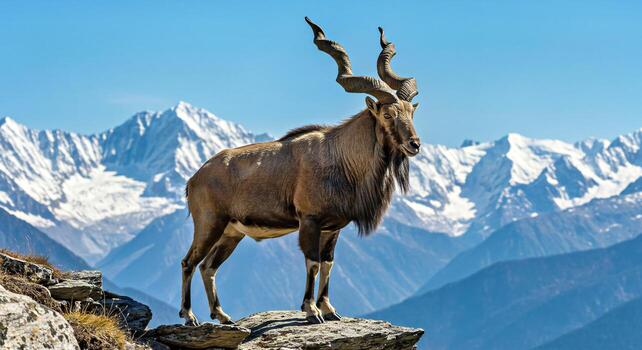
What is it?
The markhor (Capra falconeri) is the largest species of wild goat in the world. It is famous for its incredible spiraling, corkscrew-like horns. The name “markhor” comes from the Persian word markhar, meaning “curly” or “snake-eater” – based on an ancient belief that these goats would kill and eat snakes .
The markhor is the national animal of Pakistan .
Appearance
- Weight: Males 80–110 kg (176–242 lbs) | Females 32–50 kg (70–110 lbs)
- Length: 132–186 cm (52–73 inches)
- Shoulder height: 65–115 cm (26–45 inches) – tallest among wild goats
- Coat: Short and reddish-brown in summer; long, thick, and grayish in winter. Males have a long beard and a heavy fringe of hair on the throat and chest (females have smaller fringes) .
- The Horns: Both sexes have tightly curled, corkscrew-like horns that twist outward. Males can grow horns up to 160 cm (63 inches) long – that’s longer than most adult humans are tall! Female horns are much smaller (up to 25 cm / 10 inches) .
Habitat
Adapted to steep, rugged mountainous terrain between 600 and 3,600 meters (2,000–11,800 feet) elevation . Prefers open woodlands and shrub forests of oaks, pines, and junipers.
Where Usually Found?
Found across Central and South Asia in scattered populations :
| Region | Countries |
|---|---|
| South Asia | Pakistan (largest population), India (Jammu & Kashmir), Afghanistan |
| Central Asia | Tajikistan, Uzbekistan, Turkmenistan |
Three recognized subspecies :
- Flare-horned markhor (C. f. falconeri) – Afghanistan, Pakistan, India
- Bukharan markhor (C. f. heptneri) – Tajikistan, Uzbekistan, Turkmenistan, Afghanistan
- Straight-horned markhor (C. f. megaceros) – Afghanistan, Pakistan
Behavior & Diet
- Diurnal: Most active in early morning and late afternoon .
- Herbivore: Grazes on grasses in spring/summer; browses on leaves, twigs, and shrubs in winter. Often stands on hind legs to reach high branches .
- Social structure: Females live in small herds of 8–9 individuals with their young. Adult males are largely solitary .
- Mating season (rut): Winter. Males fight by lunging, locking horns, and trying to push each other off balance – a dramatic sight .
Reproduction
- Gestation: 135–170 days (5–6 months)
- Offspring: 1–2 kids, rarely 3 (born April–June)
- Weaning: 5–6 months
- Lifespan: 12–13 years in the wild
Predators
Main predators include snow leopards, wolves, lynx, and brown bears. Golden eagles may prey on young kids .
Interesting Facts
- National symbol: The markhor is the national animal of Pakistan and appears on the logo of Pakistan’s Inter-Services Intelligence (ISI) .
- Massive horns: A male’s horns can weigh nearly one-third of its total body weight – a huge investment in attracting mates .
- Snake-killer myth: Ancient peoples believed markhors actively killed and ate snakes. This likely came from the “snake-like” twisting shape of their horns .
- Excellent senses: Markhors have keen eyesight and a strong sense of smell to detect predators from far away .
- Seasonal movers: They perform short vertical migrations – moving to lower elevations in winter to escape deep snow .
- Alarm call: Their warning call sounds exactly like the bleating of a domestic goat .
- Ancestor of domestic goats? Some scientists believe the markhor may be an ancestor of certain domestic goat breeds, including the Angora goat .
Conservation Status
Near Threatened (IUCN) – population increasing but still vulnerable .
- Global population: Approximately 9,700–10,500 individuals
- Historic decline: Once near extinction due to hunting, habitat loss, and competition with livestock
- Success story: Conservation efforts (including the USFWS program in Pakistan) brought the species back from fewer than 200 animals to over 3,500 in some regions .
- Main threats: Poaching (for meat and trophy horns), habitat destruction, and armed conflict in parts of its range .
Leave a Reply