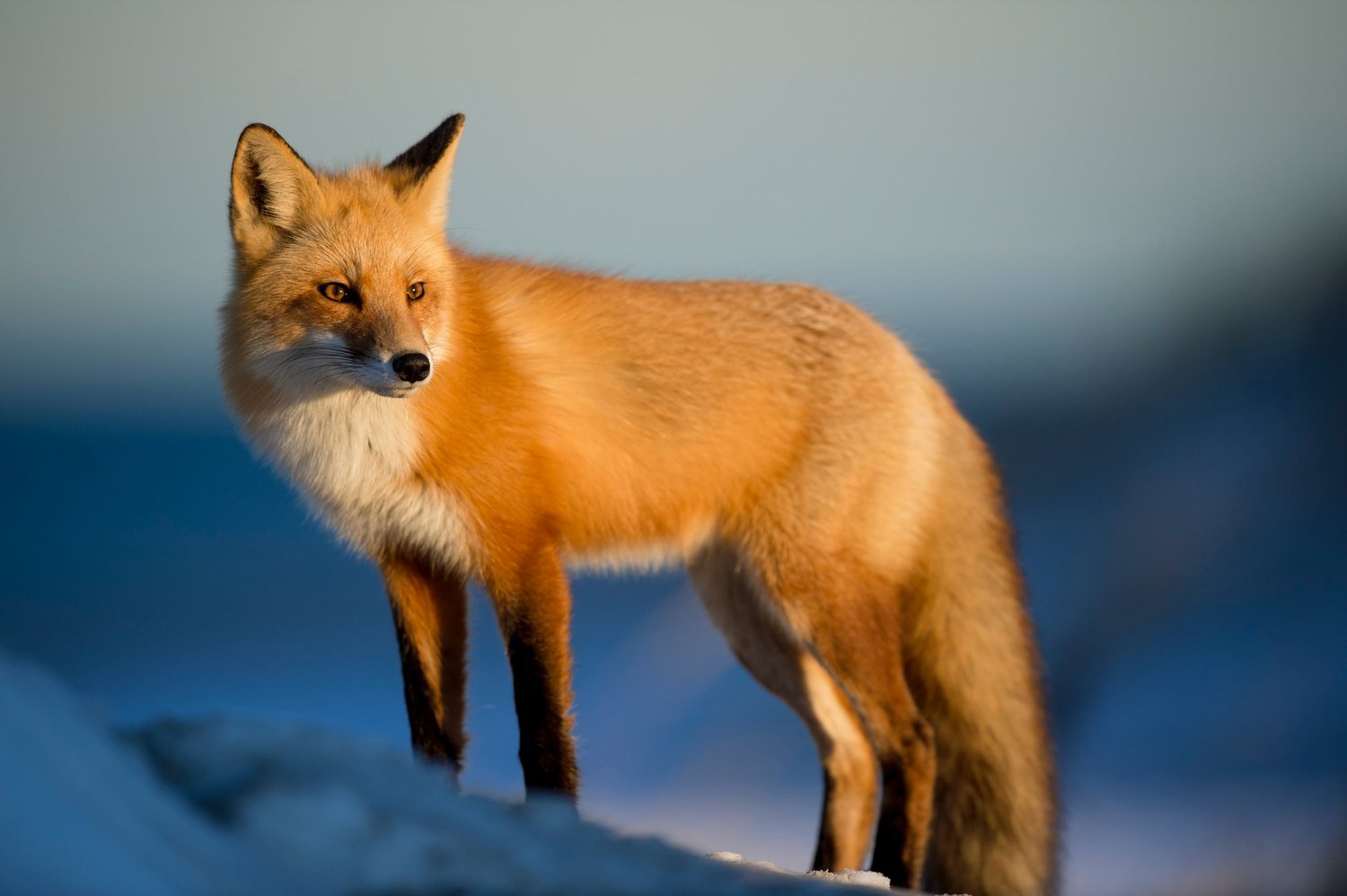
What is it?
The red fox (Vulpes vulpes) is the largest and most widespread of all true foxes. Known for its intelligence, adaptability, and fiery red coat, it is one of the most successful and widespread carnivores on Earth.
Appearance
- Weight: 3–14 kg (7–31 lbs). Males slightly larger than females.
- Length: 45–90 cm (18–35 inches) plus a long, bushy tail (30–55 cm / 12–22 inches).
- Shoulder height: 35–50 cm (14–20 inches).
- Coat: Distinctive reddish-orange fur on back, sides, and head. White underparts (chin, chest, belly) and a white-tipped tail. Black “stockings” (lower legs and paws) and black-tipped ears.
- Key features:
- Very long, bushy tail (called a “brush”)
- Slender, long-legged body
- Pointed, triangular ears that stand upright
- Narrow, pointed snout
- Vertical pupils (like a cat) – excellent for seeing in dim light
Color variations: Silver fox (black with white-tipped fur), cross fox (reddish with a dark cross on shoulders), and albino forms exist but are rare.
Habitat
The most adaptable wild carnivore on Earth. Found in almost every habitat:
- Forests (temperate, boreal, deciduous)
- Grasslands and prairies
- Deserts and semi-deserts
- Mountains (up to 4,500 meters / 14,800 feet)
- Tundra (arctic edge)
- Farmlands and rural areas
- Suburbs and cities (thrives alongside humans)
Where Usually Found?
The red fox has the largest natural range of any land carnivore (excluding humans). Found across the entire Northern Hemisphere.
| Region | Status |
|---|---|
| North America | Throughout Canada, Alaska, and most of the continental USA (except some parts of Texas and the Southwest) |
| Europe | Widespread across all of Europe (except Iceland and parts of Scandinavia) |
| Asia | Throughout Russia, China, Japan, Korea, Central Asia, India (Himalayan region), Middle East |
| North Africa | Northern Africa (Morocco, Algeria, Tunisia, Libya, Egypt) |
| Australia | Introduced (1850s for sport) – now invasive and widespread |
| Arctic | Reaches the edge of the Arctic tundra (overlaps with Arctic fox in some areas) |
Not found in: Iceland, most Arctic islands, Antarctica, South America, most of Southeast Asia.
Behavior & Diet
- Omnivore: One of the least picky eaters in the animal kingdom.
- Small mammals: Mice, voles, rats, rabbits (primary prey)
- Birds and eggs
- Insects: Grasshoppers, beetles, caterpillars
- Fruits and berries: Apples, blueberries, blackberries, grapes
- Carrion (dead animals)
- Garbage (near human settlements)
- Pet food left outside
- Solitary hunter: Hunts alone, mostly at night (nocturnal) or during dawn/dusk (crepuscular).
- Hunting technique: Uses excellent hearing (can hear a mouse squeak under 3 feet of snow). Stalks, then pounces high into the air (called “mousing”) to land on prey.
- Not a pack animal: Lives in small family groups (a mated pair and their current young). But hunts alone.
- Vocalizations: Over 20 different sounds, including barks, screams, howls, and a friendly “greeting” wiggle.
The Famous Tail (“Brush”)
- Makes up nearly one-third of total body length
- Used for:
- Balance while running and jumping
- Warmth (wraps around nose and paws while sleeping)
- Communication (tail position signals mood)
- Steering during high-speed chases
Interesting Facts
- Not a dog or cat? Foxes are canids (dog family) but share many cat-like traits: vertical pupils, retractable claws (partially), whiskers on legs, and a stealthy stalking style.
- Incredible hearing: A red fox can hear a mouse squeak from 30 meters (100 feet) away and can locate the exact spot of a digging rodent under deep snow.
- The “pounce”: Foxes use Earth’s magnetic field to hunt. They tend to jump in a northeasterly direction when pouncing on prey, regardless of wind or sun.
- City dwellers: Urban foxes are thriving in London (over 10,000), Tokyo, Berlin, and many other cities. They learn to cross streets at crosswalks and know which garbage bins are easiest to open.
- “Sly as a fox”: Foxes are extremely smart. They have been observed playing dead to attract scavenging birds, then catching them. They also “cache” (hide) extra food for later.
- Father of the year: Male red foxes are excellent fathers. They bring food to the female while she nurses the pups and continue feeding the family after the pups emerge from the den.
- Not always red: About 10% of red foxes have a “cross” pattern (dark back with a cross on shoulders). Silver foxes (black with white-tipped hairs) were prized by fur traders and helped found the domesticated fox experiment.
- Domestication experiment: In a famous 60-year Russian experiment, scientists bred silver foxes for tameness. Today, those foxes behave like friendly, floppy-eared dogs – proof that foxes can be domesticated.
- Speed: Can sprint at 50 km/h (30 mph) for short distances.
- Lifespan: 2–5 years in the wild (10–12 years in captivity). Most wild foxes die young – killed by cars, predators (coyotes, wolves, eagles), or starvation.
Reproduction
- Mating: January–February (once per year)
- Gestation: 49–58 days (about 8 weeks)
- Litter size: 4–6 pups (called “kits” or “cubs”)
- Born: March–April. Born blind, deaf, and toothless. Weigh only 100 grams (3.5 ounces).
- Den: Usually a renovated woodchuck or rabbit burrow. Sometimes under sheds or porches in cities.
- Independence: Young leave the den at 4–5 months. Females stay near mother; males disperse farther.
Predators
- Wolf, coyote, bobcat, lynx, cougar, golden eagle, great horned owl
- Humans (trapping for fur, hunting, vehicle collisions)
Conservation Status
Least Concern (IUCN) – population is stable and widespread.
- Global population: Unknown but likely in the millions (probably 7–10 million+)
- North America: Estimated 2–3 million
- Europe: Estimated 1–2 million
- Australia: Millions (invasive pest)
Threats:
- Vehicle collisions (leading cause of death in urban areas)
- Mange (parasitic skin disease caused by mites)
- Trapping and hunting for fur
- Rabies outbreaks (in some regions)
In Australia: The red fox is classified as invasive and a serious pest. It was introduced for fox hunting in the 1850s and has caused the extinction or decline of native ground-nesting birds, small marsupials, and reptiles. Australia spends millions controlling fox populations.
Leave a Reply