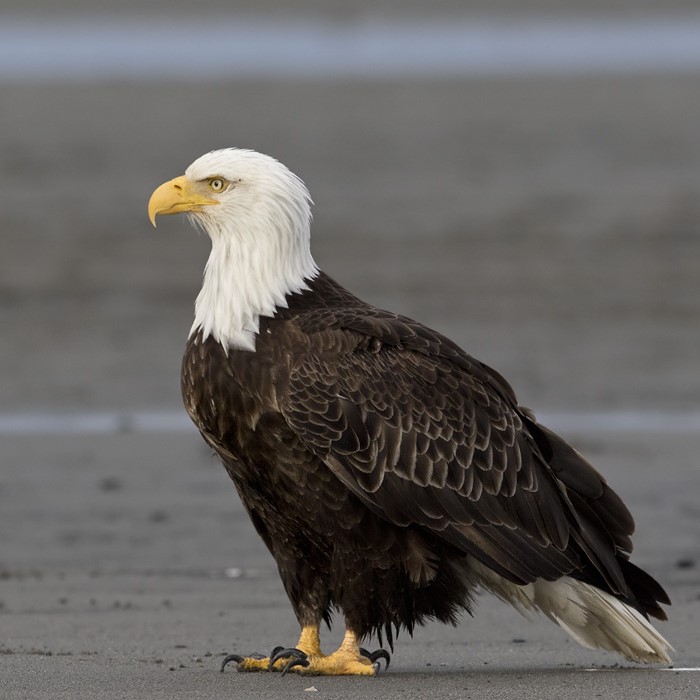
- Scientific name: Family Accipitridae (over 60 species). Includes golden eagles, bald eagles, harpy eagles, sea eagles, and more.
- Size: Varies widely – from 0.5 kg (1 lb) to 7 kg (15 lbs). Wingspan from 1 meter (3 ft) up to 2.5 meters (8 feet) for the Steller’s sea eagle.
- Appearance: Large, powerful birds with hooked beaks, strong talons, broad wings, and often a white head or tail (bald eagle). Excellent eyesight.
- Habitat: Found on every continent except Antarctica – mountains, forests, grasslands, deserts, coastlines, lakeshores, and open country.
- Where found: Worldwide:
- North America: Bald eagle, golden eagle
- South & Central America: Harpy eagle, crested eagle
- Africa: Martial eagle, African fish eagle
- Europe & Asia: Golden eagle, white-tailed eagle, steppe eagle
- Australia: Wedge-tailed eagle
- Diet: Apex predators – mainly fish, mammals (rabbits, monkeys, small deer), birds, reptiles, and carrion. Some are specialists (fish eagles eat mostly fish; harpy eagles eat monkeys and sloths).
- Hunting style: Soars high, spots prey with incredible vision (8x sharper than humans), then dives at 160–320 km/h (100–200 mph) to snatch with powerful talons.
- Talons and grip: A harpy eagle’s talons are as long as bear claws (13 cm / 5 inches). Grip strength over 400 psi – can crush a monkey’s skull.
- Nests: Build the largest nests of any bird – some weigh over 2 tons (4,400 lbs) and are 2.5 meters (8 feet) across. Used for decades.
- Lifespan: 15–30 years in wild | Up to 50 years in captivity.
- Conservation status: Varies by species.
| Species | Status |
|---|---|
| Bald eagle | Least Concern (recovered – success story) |
| Golden eagle | Least Concern |
| Harpy eagle | Near Threatened |
| Philippine eagle | Critically Endangered (fewer than 500 left) |
| Steller’s sea eagle | Vulnerable |
- Biggest threats: Habitat loss, poaching, pesticides (DDT nearly wiped out bald eagles), electrocution on power lines, lead poisoning (from eating bullet-ridden prey).
- Fun fact 1: A group of eagles is called a “convocation,” “aerie,” or “soar.”
- Fun fact 2: Bald eagles are not actually bald – “balde” is an old English word meaning “white-headed.”
- Fun fact 3: An eagle’s eyesight is so sharp it can spot a rabbit from 3 kilometers (2 miles) away.
- Fun fact 4: The Philippine eagle is the largest eagle by length (1 meter / 3 feet tall). The harpy eagle is the heaviest and most powerful.
- Symbolism: The bald eagle is the national bird of the United States. Eagles appear on flags and emblems of many countries (Germany, Egypt, Mexico, Poland, etc.).
Leave a Reply