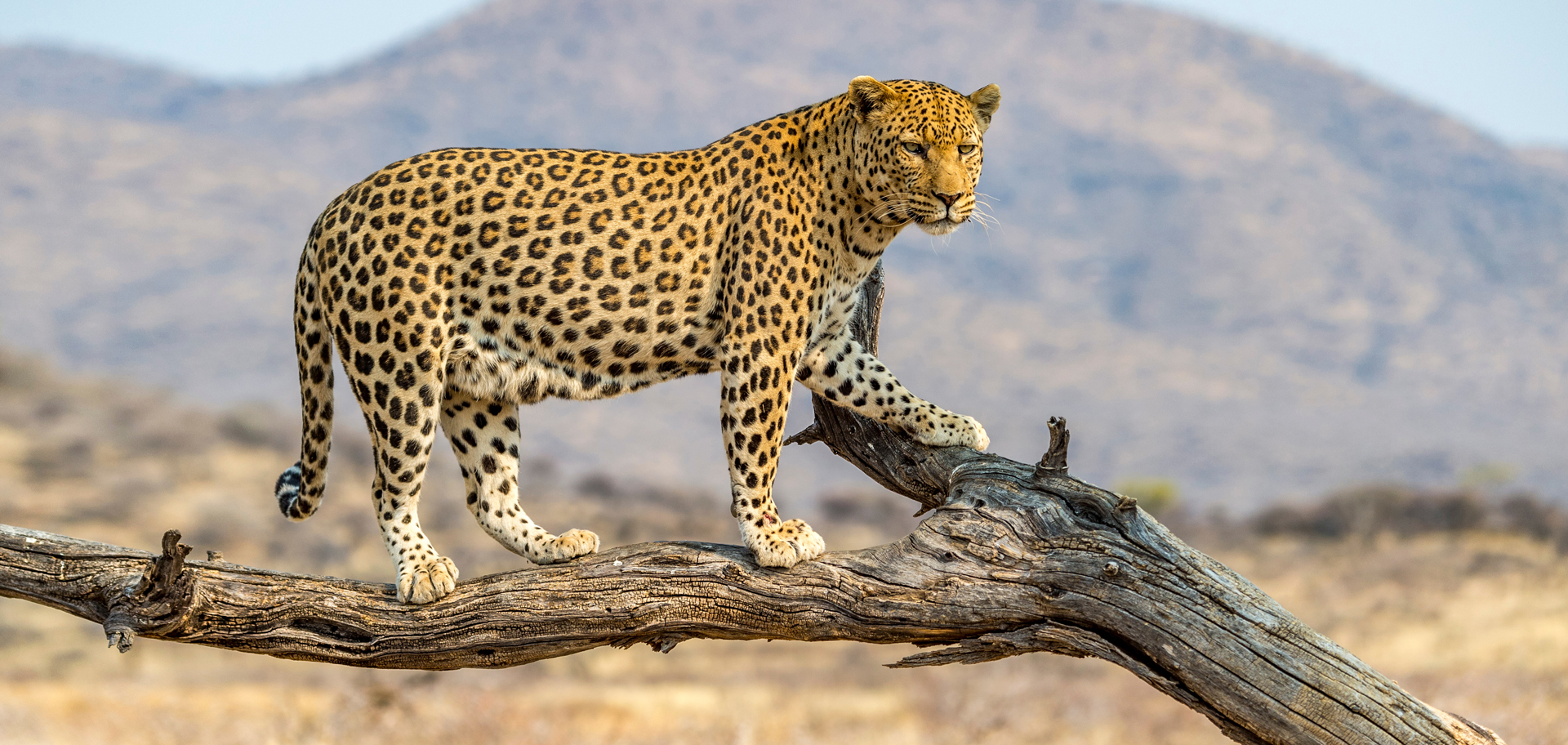
What is it?
The leopard (Panthera pardus) is one of the five “big cats” in the genus Panthera (along with lions, tigers, jaguars, and snow leopards). It is famous for its strength, stealth, and ability to thrive in almost any environment.
Appearance
- Weight: 30–90 kg (66–198 lbs). Males are larger than females.
- Length: 90–190 cm (35–75 inches) plus a 60–100 cm (24–40 inch) tail.
- Shoulder height: 45–80 cm (18–31 inches).
- Coat: Golden-yellow to pale cream with black rosettes (broken circles with a darker center). Rosettes are unique to each leopard, like a fingerprint.
- Key features:
- Long, muscular body with short, powerful legs
- Broad head with strong jaws
- Large, rounded ears
- Very long tail (used for balance while climbing)
- Melanistic (black) form: Commonly called the “black panther” (same species, just extra dark pigment – spots still visible in good light).
Habitat
Extremely adaptable. Found in more habitats than any other big cat:
- Rainforests and jungles
- Savannas and grasslands
- Deserts (including the Sahara)
- Mountains (up to 5,000 meters / 16,400 feet)
- Scrublands and rocky outcrops
- Even near cities and villages
Where Usually Found?
Leopards have the largest range of any wild cat (after domestic cats). Found across Africa and Asia.
| Region | Countries / Areas |
|---|---|
| Africa | Widespread throughout sub-Saharan Africa (rare in North Africa) |
| South Asia | India, Nepal, Bhutan, Bangladesh, Sri Lanka, Pakistan |
| Southeast Asia | Myanmar, Thailand, Malaysia, Indonesia (Java), Cambodia, Laos, Vietnam |
| East Asia | China (rare), far eastern Russia (very rare) |
| Middle East | Iran, Oman, Yemen, Saudi Arabia (very rare) |
Extinct from: Most of North Africa, the Arabian Peninsula (except tiny pockets), the Middle East (except Iran), and most of China and Southeast Asia (drastically reduced).
Behavior & Diet
- Solitary hunter: Lives and hunts alone. Only pairs during mating; mothers stay with cubs.
- Nocturnal or crepuscular: Most active at night and during dawn/dusk.
- Ambush predator: Stalks prey silently (within 5–10 meters), then explodes with a short burst of speed.
- Diet: Over 100 different prey species.
- Small to medium prey (preferred): Gazelles, impalas, deer, wild pigs, monkeys, birds, rodents.
- Will take larger prey: Young wildebeest, young zebra, antelope.
- Also eats: Fish, crabs, insects, reptiles, and even porcupines (carefully).
The Great Climber
Leopards are the best climbers among big cats. They:
- Drag kills up trees to hide them from lions, hyenas, and wild dogs.
- Sleep on branches (safe from ground predators).
- Carry prey heavier than themselves (up to 3 times their weight) into trees.
Interesting Facts
- The silent stalker: Leopards are so stealthy that they can walk without making a sound. They pad the ground with their paws, and their loose shoulder blades absorb noise.
- Strength beyond size: A leopard can carry a 180 kg (400 lb) antelope up a vertical tree trunk. This requires the strength of about 10 adult humans.
- “Panther” is not a species: Black panthers are just leopards (or jaguars) with melanism. In good light, their rosettes are still visible.
- Extreme adaptability: Leopards survive in deserts (drinking water only once every 10 days), rainforests, snowy mountains, and even the edges of Mumbai, India (where they hunt stray dogs at night).
- Masters of disguise: Their rosettes act as “disruptive coloration” – the pattern breaks up their outline, making them invisible in dappled sunlight and shadows.
- Hissing roar: Leopards can roar (unlike snow leopards), but their roar sounds more like a raspy, sawing cough repeated several times. They also make a sound called “sawing” to announce territory.
- Fast but not for long: They sprint at 55–60 km/h (35–37 mph) but only for 100–200 meters. They rely on surprise, not endurance.
- Danger to humans? Leopards rarely attack people. However, when injured, old, or unable to hunt wild prey, they can become man-eaters. The most famous was the “Panar Leopard” (India, early 1900s) – killed over 400 people. But such cases are extremely rare.
- Nine subspecies:
- African leopard (most common)
- Indian leopard
- Javan leopard (critically endangered)
- Arabian leopard (critically endangered – fewer than 200)
- Persian leopard (endangered)
- Amur leopard (critically endangered – fewer than 100 in the wild)
- Indochinese leopard
- Sri Lankan leopard
- North Chinese leopard (critically endangered)
- Long tail for balance: Their tail is almost as long as their body. It acts like a tightrope walker’s pole – critical for climbing and sudden turns while chasing prey.
Leopard vs. Other Spotted Cats
| Feature | Leopard | Cheetah | Jaguar | Snow Leopard |
|---|---|---|---|---|
| Spot pattern | Rosettes (broken circles) | Solid black spots | Rosettes with dots inside | Large rosettes, no center |
| Build | Stocky, muscular | Slender, long-legged | Very stocky, heavy | Stocky, thick fur |
| Climbs trees | Excellent | Poor (short claws) | Excellent | Very good |
| Roars? | Yes (sawing cough) | No (purrs like a cat) | Yes (deep roar) | No (chuffs) |
| Habitat | Africa & Asia | Africa (mostly) | Central & South America | Central Asia mountains |
Conservation Status
Vulnerable (IUCN). Population is decreasing. Estimated 250,000–300,000 in Africa, but only 50,000–70,000 in Asia.
Major threats:
- Habitat loss (deforestation, farming, cities)
- Poaching for fur and body parts (traditional medicine in Asia)
- Human-wildlife conflict (killed for attacking livestock)
- Decline of prey (overhunting of deer, gazelles, wild pigs)
Most endangered subspecies:
- Amur leopard: Fewer than 100 left (far eastern Russia, China)
- Arabian leopard: Fewer than 200 left (Oman, Yemen, Saudi Arabia)
- Javan leopard: Fewer than 250 left (Indonesia)
Leave a Reply