What is it?
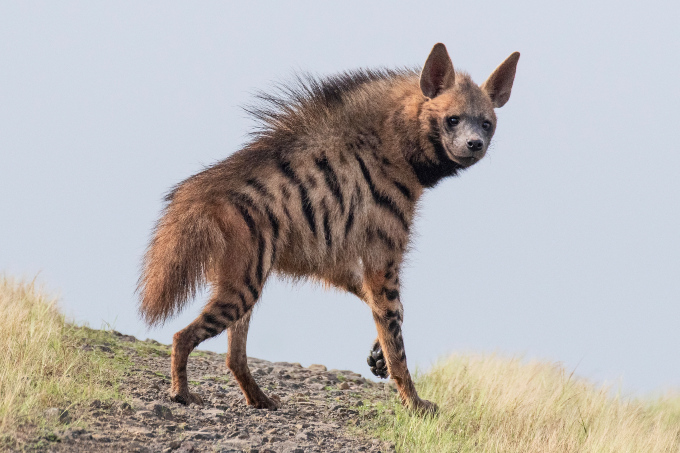
The striped hyena (Hyaena hyaena) is a medium-sized scavenger, known for its distinctive striped coat and famous “laugh.” It is shyer and more solitary than the better-known spotted hyena.
Appearance
- Weight: 22–55 kg (48–121 lbs)
- Length: 85–130 cm (33–51 inches) plus a 25–40 cm (10–16 inch) tail
- Shoulder height: 60–80 cm (24–31 inches)
- Coat: Grayish-brown or beige with distinct black vertical stripes on the body and legs
- Key features:
- Thick, muscular neck and shoulders
- Long, bushy tail
- Large, pointed ears
- A mane of long hair running from the back of the head to the tail (erects when threatened, making it look bigger)
Habitat
Dry, open country:
- Semi-deserts and deserts
- Scrublands and savannas
- Rocky hills and ravines
- Avoids dense forests and high mountains
Where Usually Found?
Found across North and East Africa, the Middle East, and South Asia.
| Region | Countries |
|---|---|
| Africa | Morocco, Algeria, Tunisia, Libya, Egypt, Sudan, Ethiopia, Somalia, Kenya, Tanzania |
| Middle East | Israel, Jordan, Saudi Arabia, Iran, Iraq, Afghanistan, Pakistan |
| South Asia | India (especially Rajasthan, Gujarat, Madhya Pradesh), Nepal |
Note: The striped hyena is extinct or extremely rare in many parts of its former range (most of Europe, Turkey, the Caucasus).
Behavior & Diet
- Primarily a scavenger: Eats carcasses of large animals (deer, cattle, camels) left by tigers, leopards, or wolves.
- Not picky: Also eats insects, fruits, melons, eggs, small mammals, reptiles, and even garbage near villages.
- Solitary or in pairs: Unlike spotted hyenas (which live in large clans), striped hyenas live alone or in small family groups (male-female pair with cubs).
- Nocturnal: Sleeps in caves, rock crevices, or thick bushes during the day. Hunts/forages at night.
- Weak hunter: Lacks the speed and power of spotted hyenas. Rarely kills its own prey (only small animals like hares, rodents, birds).
The “Laugh” and Other Sounds
- Giggle/laugh: Usually a sign of excitement or submission (not actual humor).
- Howl: A long, eerie, wailing call used to communicate with other hyenas over long distances.
- Growl and grunt: Warning or aggression.
- “Whoop” sound: A series of short calls repeated every few seconds.
Interesting Facts
- No laughing matter: Striped hyenas can crush and digest bones, horns, and hooves thanks to incredibly powerful jaws and strong stomach acid.
- Not a dog or cat: Hyenas are closer to cats than dogs genetically, but belong to their own unique family (Hyaenidae).
- Folklore and fear: In many cultures (especially South Asia and the Middle East), striped hyenas are believed to be witches, grave-diggers, or shape-shifters. This superstition leads to persecution.
- Man-eater? Very rare. Unlike spotted hyenas (which have attacked humans in Africa), striped hyenas are shy and avoid people. Only a handful of attacks are recorded, usually involving rabid animals.
- Digging experts: They dig their own dens or enlarge existing burrows made by porcupines or foxes. A single den may be used for years.
- “Paste” marking: Hyenas produce a thick, smelly paste from their anal glands and smear it on grass and rocks to mark their territory.
- Tail language: When threatened, a striped hyena raises its mane and tucks its tail between its legs (submission). When excited, the tail sticks straight up.
- Good mother: Female gives birth to 2–4 cubs in a hidden den. Cubs are born with eyes open and stripes visible. Mother moves them to a new den every few weeks to avoid predators.
Conservation Status
Near Threatened (IUCN). Population is declining. Estimated 5,000–10,000 remain in the wild.
Major threats:
- Persecution by humans: Poisoned, shot, or trapped because they are seen as dirty, dangerous, or bad luck.
- Habitat loss: Conversion of wild land to farms and cities.
- Roadkill: Killed by vehicles at night.
- Decline of carcasses: As wild prey (gazelles, deer) disappear, hyenas lose their food source.
Range: Extinct from at least 10 countries (most of Europe, Senegal, Israel? – nearly extinct there). Still present but rare in most of Africa and Asia.
Striped vs. Spotted Hyena: Quick Comparison
| Feature | Striped Hyena | Spotted Hyena |
|---|---|---|
| Stripes | Yes (black stripes on body) | No (spots only) |
| Social life | Solitary or pairs | Large clans (up to 80) |
| Hunting skill | Weak scavenger | Powerful pack hunter |
| “Laugh” | Less common, softer | Loud, famous “giggle” |
| Range | North/East Africa, Asia | Sub-Saharan Africa only |
| Size | Smaller | Larger |
Leave a Reply