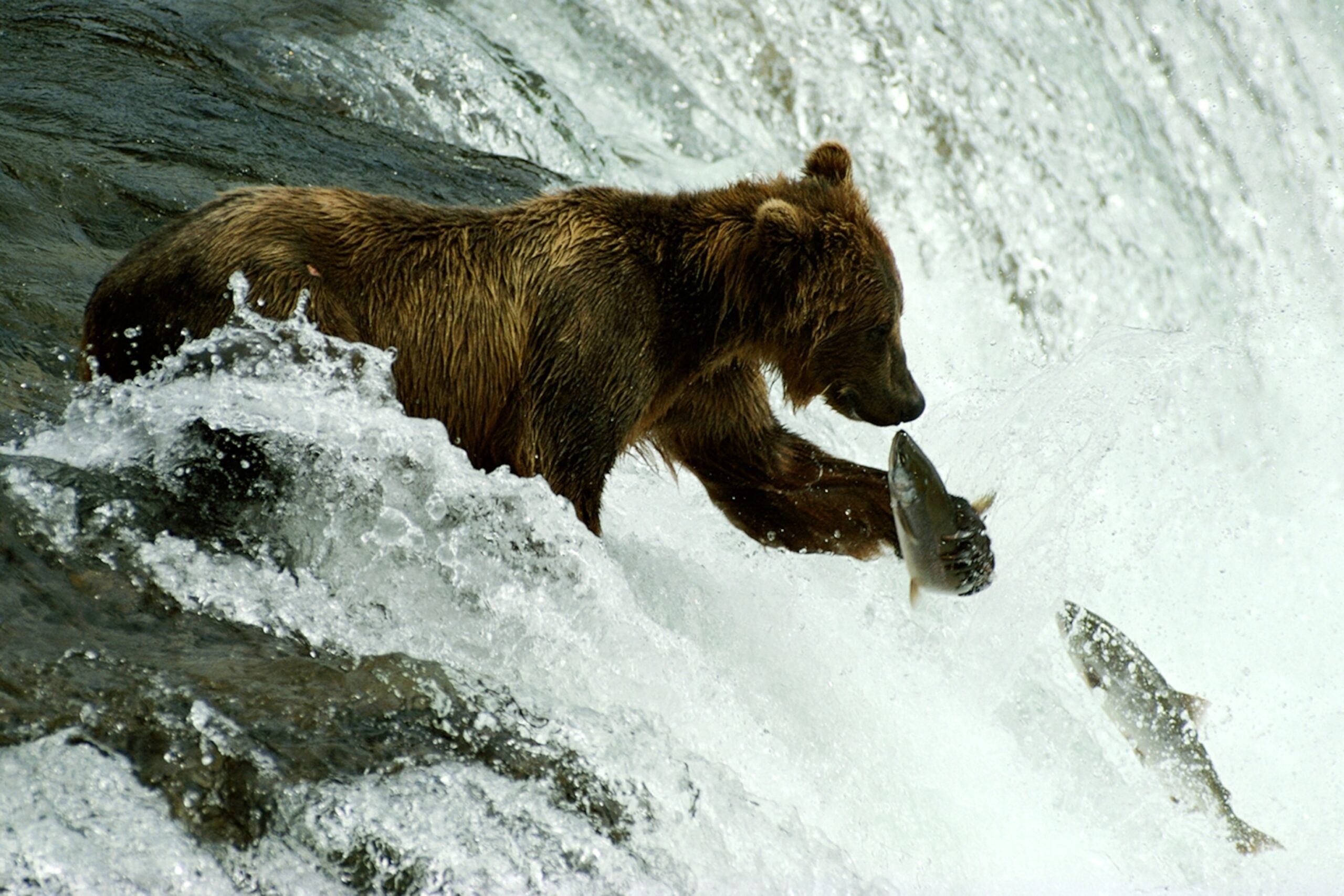
What is it?
The brown bear (Ursus arctos) is one of the largest and most powerful land predators on Earth. It is the most widely distributed bear species and includes famous subspecies like the Grizzly bear (North America) and the Eurasian brown bear.
Appearance
- Coat: Thick fur ranging from light cream to dark brown, almost black. The famous “grizzly” has white-tipped hairs that give a “grizzled” look.
- Hump: A large, muscular hump on the shoulders – made of pure muscle, not fat. It gives bears incredible digging and swatting power.
- Claws: Long (up to 4 inches / 10 cm), curved, and blunt. Used for digging roots, dens, and prey, not for climbing.
- Size: Heavily varies by region.
- Coastal (Alaska): Up to 780 kg (1,720 lbs)
- Inland (Rockies): 180–360 kg (400–800 lbs)
- Standing height: 1.5–3 meters (5–10 feet) on hind legs
Habitat
Extremely diverse. Found in North America, Europe, and Asia. Lives in:
- Forests and woodlands
- Alpine meadows and mountains
- Tundra and arctic edges
- Coastal shorelines (where salmon spawn)
Where Usually Found?
The largest populations are in:
- Russia (largest population – over 100,000)
- United States (Alaska – about 30,000)
- Canada (about 25,000)
- Romania, Turkey, Finland, Sweden, and the Carpathian Mountains
Note: In the lower 48 US states, only a few hundred remain (Yellowstone, Glacier National Park). They have been wiped out from most of Western Europe and Mexico.
Behavior & Diet
- Omnivore: Eats almost anything. Grass, berries, roots, nuts, insects, fish (salmon), small mammals, deer, moose, and carrion.
- Hibernation: Sleeps through winter (5–8 months) in a den. They do not eat, drink, pee, or poo during this time. Heart rate drops from 40 to 10 beats per minute.
- Solitary: Adults live alone, except for mothers with cubs.
- Incredible swimmers and runners: Can sprint up to 35–40 mph (56–64 kph) – faster than a horse. They can outrun a human uphill, downhill, or on flat ground.
Interesting Facts
- Huge appetite: A coastal brown bear may eat 80–90 pounds of salmon per day before hibernation. That’s like eating 300 hamburgers daily.
- Born in the den: Mother bears give birth during winter hibernation while sleeping. Cubs are tiny (1 pound) and nurse until spring.
- Excellent memory: They remember food sources for decades and have a sense of smell 7 times better than a bloodhound.
- Grizzly vs. Brown bear: Same species. “Grizzly” refers to inland bears with less food (smaller size). Coastal bears with salmon are simply “brown bears.”
- Avoids humans generally: Despite Hollywood movies, most brown bears will flee if they sense a human. Attacks are rare but can be deadly if surprised or protecting cubs.
- Not a polar bear hybrid? They sometimes mate with polar bears in the wild, producing a hybrid called a “pizzly” or “grolar bear.”
Conservation Status
Least Concern (globally). Population is stable at roughly 200,000 worldwide. However, some populations are endangered:
- Threats: Habitat loss, hunting, human-wildlife conflict, climate change (affects salmon runs and berry seasons).
- Endangered populations: Grizzly bears in the lower 48 USA (protected), brown bears in Spain and Italy (fewer than 100 each).
- Success story: Yellowstone grizzlies have rebounded from 136 in 1975 to over 700 today.
Leave a Reply